标签: Cybervelo E-Bike

  • How to Choose the Perfect Outdoor Electric Bike

    How to Choose the Perfect Outdoor Electric Bike

    Buying an e-bike for outdoor adventures sounds simple until you actually start shopping.

    You find yourself staring at spec sheets packed with numbers: 750W hub motors, 48V batteries, 20-inch versus 26-inch fat tires, and foldability options. If you’ve ever wondered why two bikes with similar power ratings feel completely different on a steep dirt trail, you aren’t alone.

    Most outdoor enthusiasts don’t get stuck on the math. They get stuck on matching the specs to their actual riding scenarios. Will a compact folding bike handle loose gravel? Do you really need a massive 26×4.0 tire setup, or will a nimble 20-inch tire serve your weekend camping trips better?

    In this guide, we break down what actually matters when picking an off-road e-bike, cutting through the spec-sheet noise so you can choose a ride that matches your terrain, storage space, and performance goals.

    Motors and Torque: Power for Climbing vs. Efficiency for Cruising

    When tackling unpaved paths, motor responsiveness matters more than raw speed. While top speed gets the headlines, torque (measured in Nm) dictates how smoothly your e-bike tackles incline, mud, and soft terrain.

    • Hub Motors vs. Terrain Resistance: Rear hub motors provide strong straight-line momentum, making them ideal for fire roads, packed dirt, and everyday trail riding.
    • Sizing Your Power Needs: For light trail riding and flat path cruising, a balanced motor setup provides smooth assistance without rapidly depleting your battery. For aggressive off-roading, higher peak wattage and torque become non-negotiable to prevent motor overheating during steep ascents.

    Tire Dimensions: Finding the Sweet Spot for Traction and Control

    Tires are your only point of contact with the trail. The width and diameter directly dictate your bike’s stability, roll-over capability, and comfort.

    20″ x 3.0″ — The All-Around Versatility Pick

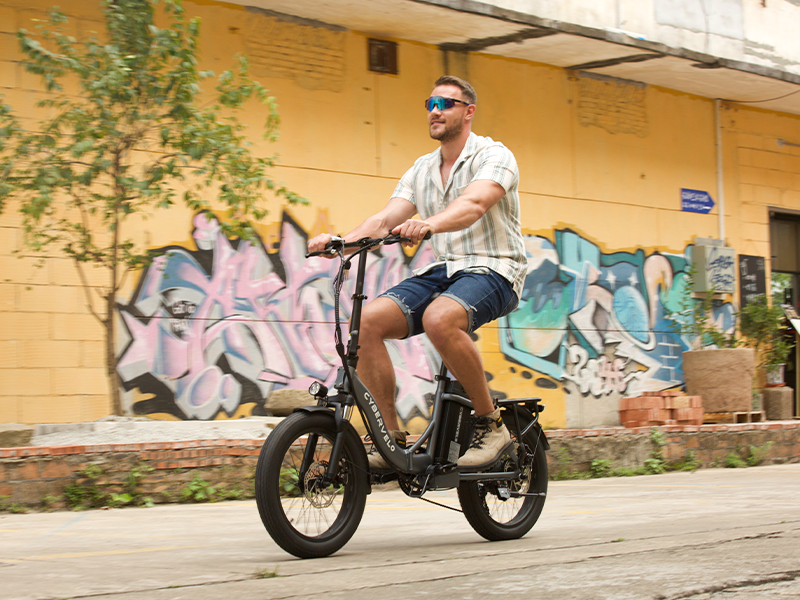
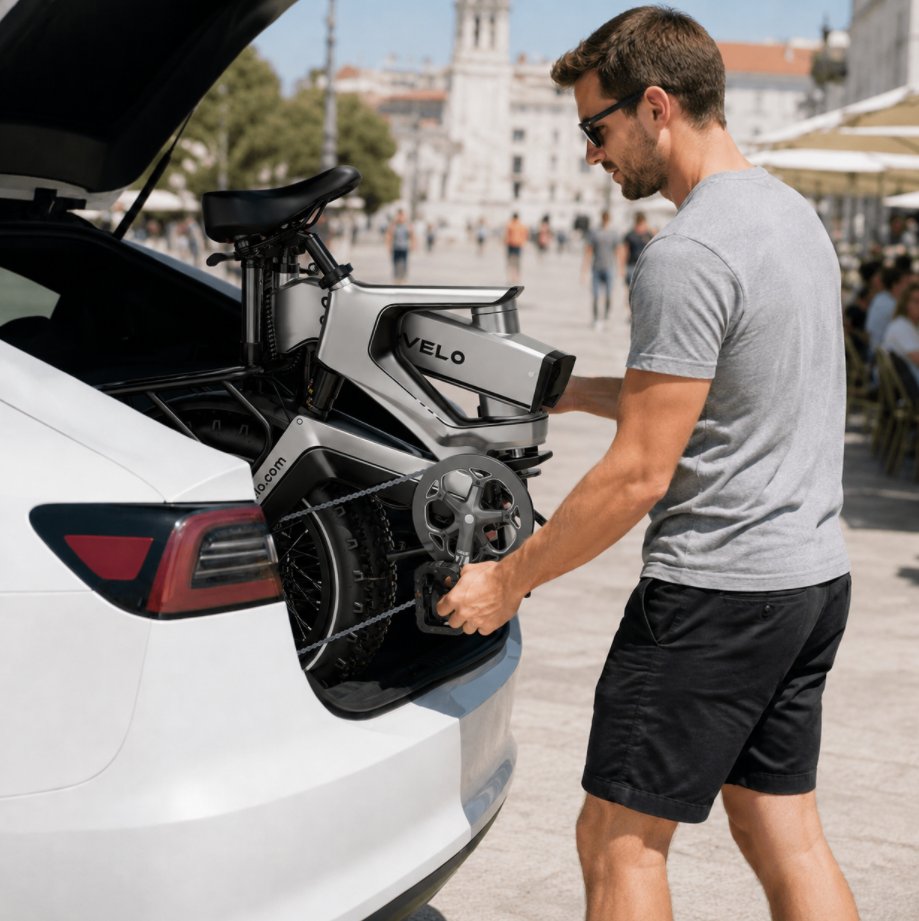
    If you need a bike that handles light dirt tracks during the weekend but folds easily into an SUV trunk, a 3.0-inch width strikes a balance between trail grip and pavement efficiency.

    • Real-World Fit: Riders who prioritize easy transport and flickable steering on mixed terrain.
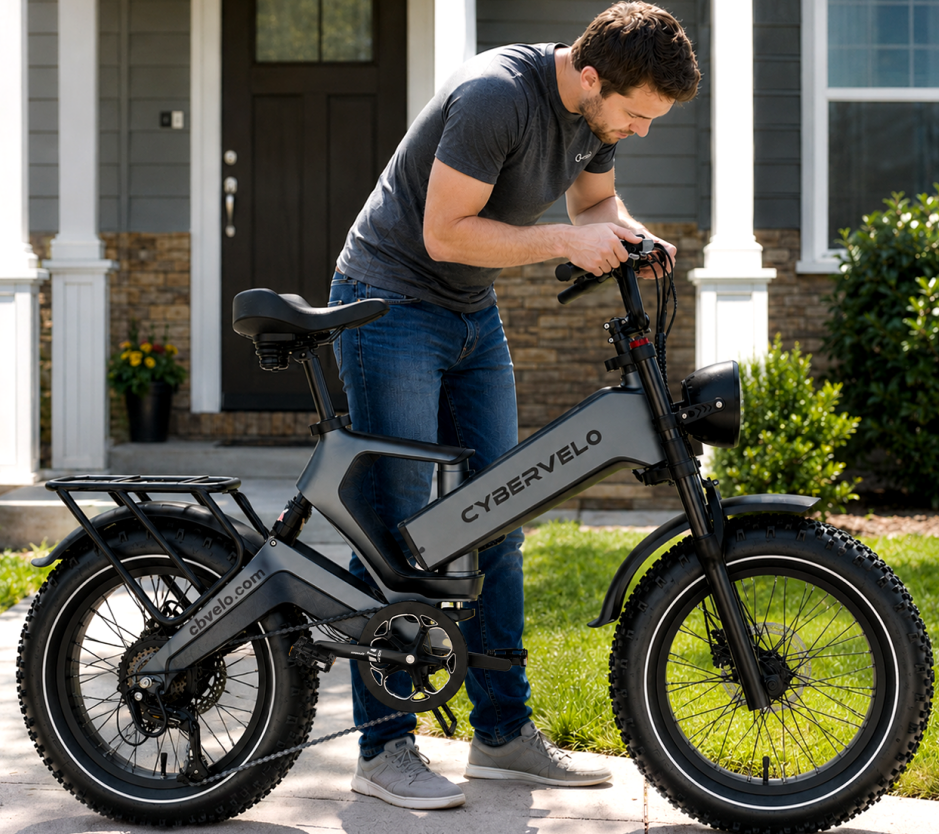
    • Featured Model: The Cybervelo EK4 Folding Fat Tire Electric Bike combines a compact footprint with 3.0-inch tires, making it an excellent bridge between city commuting and weekend outdoor exploration.

    20″ x 4.0″ — Compact Stability for Tougher Paths

    Four-inch wide fat tires act as passive suspension. Running lower PSI (pounds per square inch) in a 4.0-inch tire allows the rubber to conform over rocks, exposed roots, and loose sand.

    • Real-World Fit: Riders who want high stability and maximum traction without moving up to a full-sized frame.
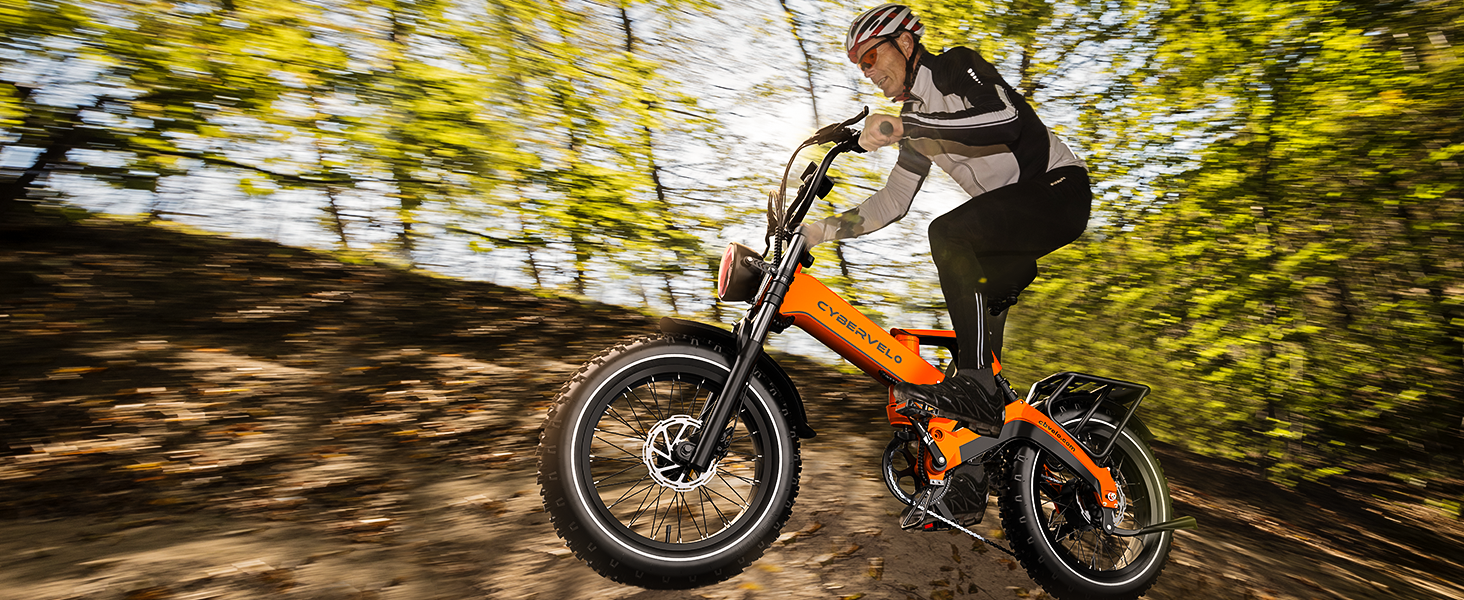
    • High-Performance Choice: For serious off-road trail capability in a compact package, the Cybervelo EK6 Folding Electric Bike is engineered specifically to handle moderate to heavy off-road conditions while retaining a space-saving frame design.
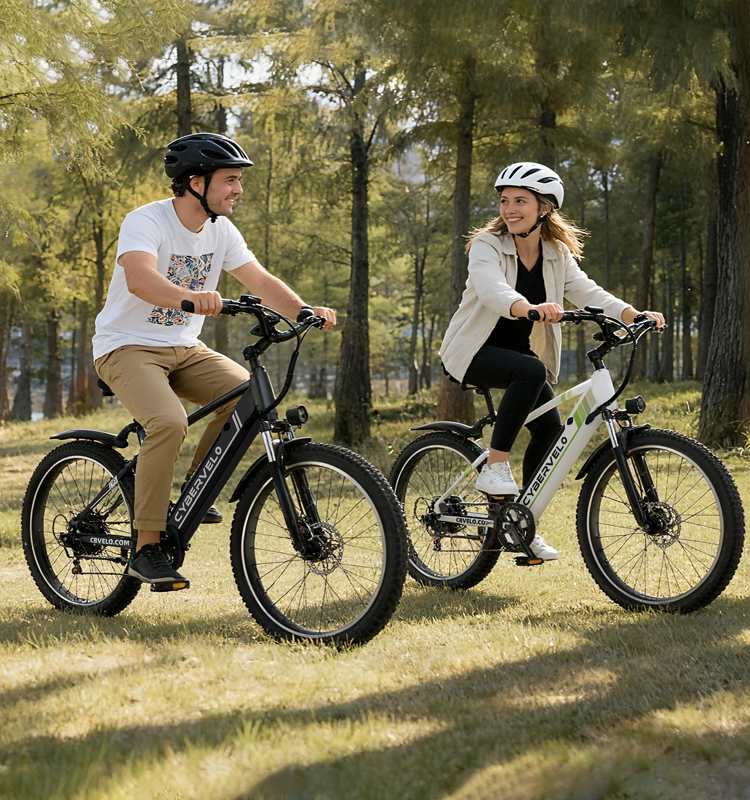
    • Versatile Alternatives: If you prefer rugged builds with tailored ergonomics for varied outdoors setups, consider testing models like the Cybervelo EK8 or exploring the heavy-duty layout of the Cybervelo EK11.

    26″ x 4.0″ — Full-Size Trail Domination

    A larger wheel diameter changes attack angles completely. 26-inch wheels roll over large obstacles, deep ruts, and logs far easier than smaller wheels, offering superior momentum over rough terrain.

    • Real-World Fit: Riders attacking backcountry routes, deep mud, or steep mountain paths where obstacle clearance is priority number one.
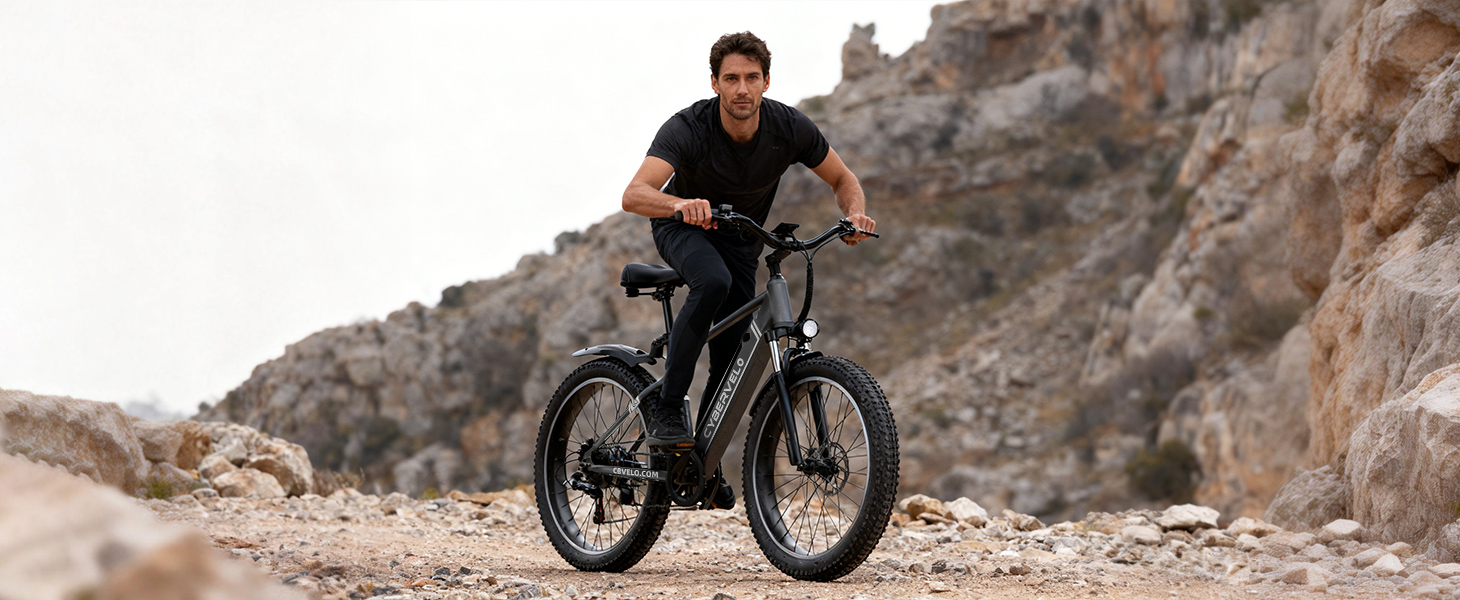
    • Trail Beast: The Cybervelo EK9 Full-Size Fat Tire E-Bike packs a full 26×4.0 tire setup built specifically for moderate-to-high off-road performance across demanding wilderness trails.

    Battery Capacity and Frame Architecture

    A powerful motor is useless if your battery drains halfway up the trail. When evaluating power systems for outdoor use, focus on Watt-Hours (Wh = Volts x Amp-Hours).

    • Real Range Expectations: Off-road riding uses significantly more energy than flat city riding. Soft dirt, low tire pressure, and heavy hill climbs can reduce estimated range by 30% to 50%. Always opt for higher amp-hour capacity if you plan long backcountry loops.
    • Folding vs. Rigid Frames: * Folding Frames: Highly practical if you camp, RV, or transport your bike in a vehicle without installing an expensive hitch rack.
    • Full-Size Frames: Offer maximal frame stiffness and traditional geometry for aggressive trail riding.

    Quick Buyer’s Checklist: Matching Your Riding Style

    Riding Style / TerrainPrimary NeedRecommended SetupBest Model Match
    Camping & Casual TrailsPortability & Moderate Grip20″ x 3.0″ Tires, Folding FrameCybervelo EK4
    Mixed Rough Trails & SandHigh Traction & Easy Storage20″ x 4.0″ Fat Tires, Reinforced FrameCybervelo EK6 / EK8 / EK11
    Heavy Off-Road & BackcountryMax Obstacle Clearance & Stability26″ x 4.0″ Fat Tires, Full FrameCybervelo EK9

    Choosing What Fits Your Adventure

    Selecting the right outdoor e-bike comes down to honest self-assessment. If you value easy transport, storage convenience, and versatile trail capability, a 20-inch fat-tire folding bike is hard to beat. If you are chasing raw trail performance over massive obstacles, stepped roots, and deep ruts, a 26-inch platform is the clear choice.

    Ready to take your outdoor adventures off the beaten path? Explore the full setup details on the model links above to find the build that matches your next trail run.

  • The Ultimate Ebike Motor Buying Guide 2026: Choosing the Right Power for Your Riding Style

    The Ultimate Ebike Motor Buying Guide 2026: Choosing the Right Power for Your Riding Style

    Buying an electric bike can quickly become overwhelming when you start comparing spec sheets. You see numbers like 750W, 1000W, or even 5000W thrown around, but what do those figures actually mean for your daily ride?

    Pick a motor with too little power, and you will find yourself pedaling furiously up moderate hills while traffic whizzes past. Pick way too much power, and you might end up paying extra for battery weight and speed you will never realistically use on city paths.

    Matching your motor power to your everyday riding environment is the single most important decision you will make. Let us skip the jargon and break down exactly how much e-bike power you really need.

    The City Rider’s Sweet Spot: 750W Motors

    For most everyday commuters and weekend suburban riders, a 750W motor strikes the perfect balance between efficiency, range, and agility. It provides enough kick to help you breeze through headwinds and handle standard overpasses without breaking a sweat.

    If your ideal route involves running errands, daily work commutes, or easy weekend trails, this tier offers plenty of responsiveness without feeling heavy or sluggish. A versatile option in this category is the Cybervelo EK5 folding electric bike, which packs a reliable 750W setup into a compact frame that easily fits into apartment closets or car trunks.

    All-Rounders & Hill Climbers: 1000W Motors

    If you live in a hilly area, carry heavy cargo, or simply want faster acceleration at traffic lights, stepping up to a 1000W motor changes the game completely. The extra wattage gives you the torque needed to tackle steeper inclines without losing momentum.

    Because riding styles vary so widely, manufacturers use 1000W setups across several frame designs:

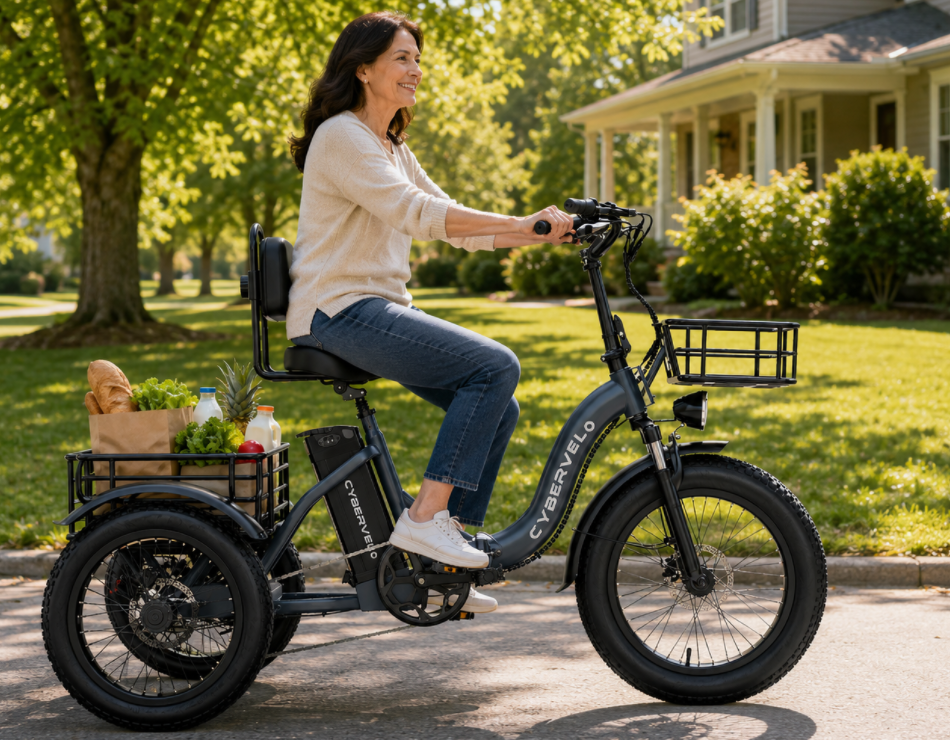
    • Easy Access Step-Throughs: For riders who want maximum comfort during urban commutes, a frame like the Cybervelo EK2 step-through ebike makes hopping on and off effortless while retaining strong hill-climbing power.
    • All-Terrain Fat Tire Folders: If you need to combine off-road grip with easy storage, the Cybervelo EK4 folding fat tire electric bike uses wide tires paired with a 1000W motor to glide over sand, gravel, and snow.
    • Full-Size Commuters & Cruiser Styles: For standard daily riding with enhanced stability, the classic Cybervelo EK7 26-inch ebike delivers smooth road performance, while options like the Cybervelo EK8 provide robust power for longer-distance journeys.

    High Performance & Off-Road Beasts: 1500W to 5000W+

    When asphalt gives way to deep forest trails, mud, or private off-road tracks, standard commuter power will not cut it. Heavy-duty off-road riding demands raw torque and high peak output to overcome loose terrain and steep mountain inclines.

    For riders wanting serious trail performance while maintaining a portable footprint, a high-torque option like the Cybervelo EK6 folding electric bike brings a beefy 1500W setup to rougher routes.

    However, if you are looking for dirt-bike levels of acceleration and pure off-road adrenaline, you enter the extreme power category. The extreme Cybervelo EK9 off-road e-bike pushes a massive 5000W output, built specifically for dedicated off-road enthusiasts who treat steep dirt trails like their personal playground.

    Quick Decision Framework: Which Power Level Fits You?

    • Choose 750W if: You ride mostly on flat pavement, value portability, and want maximum battery efficiency.
    • Choose 1000W if: You face daily hills, carry heavy gear, or want all-terrain capability without sacrificing comfort.
    • Choose 1500W–5000W if: You spend your time off-road, tackle steep mountain trails, and prioritize high torque over urban compliance.

    Focus on where you ride 80% of the time rather than edge cases. Getting the right motor match ensures your e-bike stays fun, efficient, and reliable for years to come.

  • How to Choose an E-Bike Battery Size and Avoid Range Anxiety

    How to Choose an E-Bike Battery Size and Avoid Range Anxiety

    Finding the perfect electric bike isn’t just about picking a frame style or a color you like. If you are planning to ditch your car or skip the crowded subway for your daily commute, the most critical decision you will make comes down to the battery.

    We see it all the time: a commuter buys a sleek new E-bike, only to realize two weeks later that they are suffering from severe “range anxiety” on their way home, or conversely, they overpaid thousands for a massive, heavy battery they never fully utilize.

    Choosing the right E-bike battery capacity based on your actual daily commuting distance is the secret to getting the best value for your money. Let’s break down how to calculate your actual needs and match you with the perfect ride.

    The Golden Rule: Wh vs. Ah (And Why It Matters to Your Commute)

    Before looking at models, let’s clear up the tech jargon. When browsing E-bikes, you will see battery specs written in two ways: Amp-hours (Ah) and Watt-hours (Wh).

    Think of Voltage (V) as the pressure pushing the power, Amp-hours (Ah) as the size of the gas tank, and Watt-hours (Wh) as the total amount of energy available. If a brand only gives you the Voltage and Amp-hours, you can easily find the total capacity using a simple formula: 

    Watt-hours (Wh)= Voltage (V)Amp-hours (Ah)

    For example, a standard 48V 20Ah battery gives you exactly 960Wh of energy. As a general rule of thumb, most riders consume about 20Wh per mile under real-world conditions. However, factor in headwinds, stop-and-go city traffic, and hills, and that consumption can fluctuate. To assist you in estimating your potential real-world range under various conditions, you can consult specialized industry tools like the Bosch E-Bike Range Assistant to see how terrain and weight impact battery life.

    Short-Distance Commutes (Under 15 Miles Round Trip)

    If your office is just a few miles away and your route is mostly flat city pavement, you don’t need a heavy, oversized battery. You want something agile, easy to park, or even foldable if you need to bring it upstairs to your apartment.

    For this lifestyle, a battery capacity around 700Wh to 960Wh is the sweet spot. It gives you enough juice for 2–3 days of commuting without needing a charge every single night.

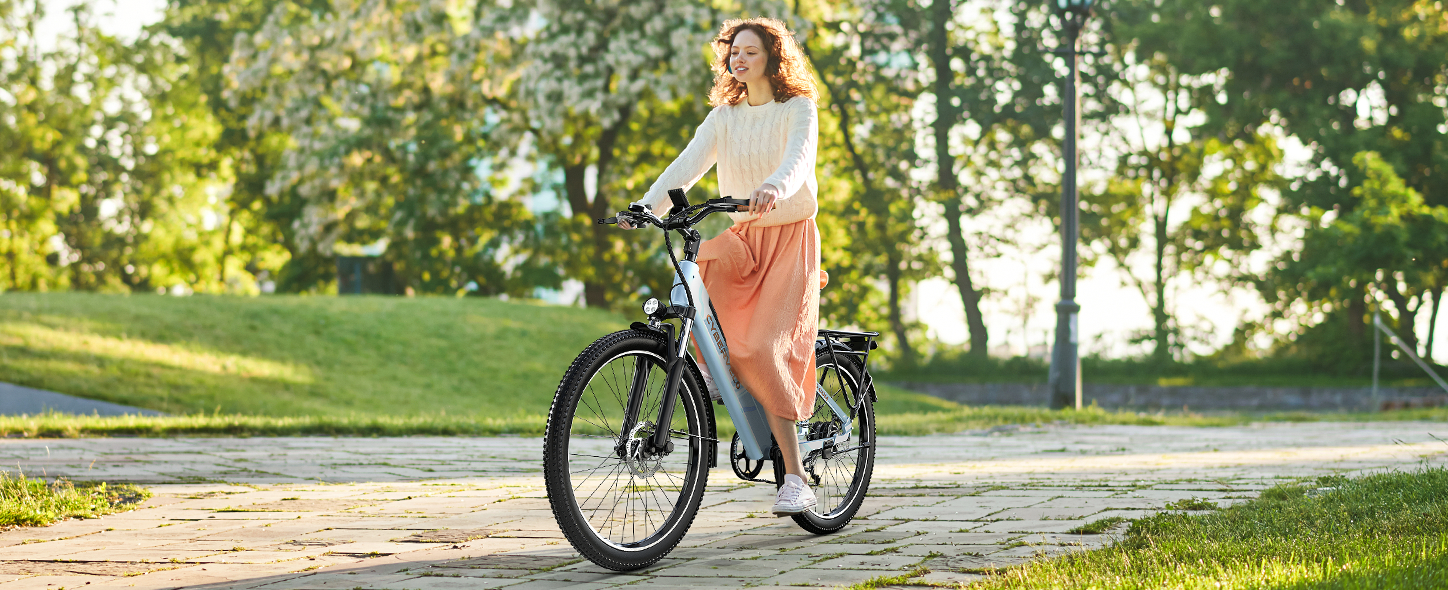
    • The Non-Folding Choice: Look at options like the Cybervelo EK2 Step-Through Ebike. Featuring a 48V 720Wh battery, its step-through frame makes it incredibly easy to hop on and off in work clothes, offering plenty of power for quick city dashes.
    • The Compact Folding Choice: If office space is tight, the Cybervelo EK5 Folding Electric Bike pack a punch with a 48V 20Ah setup. It folds down in seconds but doesn’t compromise on range, meaning you can easily go the distance and store it right under your desk.

    Medium to Long-Distance Commutes (15 to 35 Miles Round Trip)

    This is where range anxiety usually kicks in. If your commute takes you across town, over bridges, or through hilly suburban roads, a standard budget battery won’t cut it. You need sustained power that won’t drop off when the battery hits 30%.

    For medium-to-long commutes, you should aim for 960Wh to 1200Wh. This ensures you can ride comfortably on higher pedal-assist levels without panicking on your way home.

    • The Heavy-Duty Commuter: The Cybervelo EK7 26″ Through Ebike comes equipped with a robust 48V 25Ah battery. This non-folding model is built for riders who treat their E-bike as a true car replacement, offering the stability of a full-sized frame with massive energy reserves.
    • The Multipurpose Folder: If you prefer fat tires to handle rougher patches on your longer commute, the Cybervelo Mars700 48V 20Ah bridges the gap perfectly between rugged durability and convenient storage.

    Mega Commutes & Commercial Deliveries (35+ Miles or All-Day Riding)

    Are you riding over 40 miles a day? Or maybe you are using your bike for gig-economy deliveries? In this bracket, regular charging intervals aren’t an option. You need a massive power station on wheels.

    • The Ultimate Range Monster: This is where specialized engineering comes in. The Cybervelo EK4 Folding Fat Tire Electric Bike boasts an astonishing 48V 50Ah capacity. That is a massive 2400Wh of total energy. It is designed specifically for extreme distances, heavy cargo loads, or all-day commercial use where downtime is not an option.

    Real-World Factors That “Steal” Your Battery Range

    Remember, advertised ranges are often calculated based on a 150-lb rider cruising on flat ground with zero wind. In the real world, keep these three factors in mind:

    1. The Throttle Penalty: Using the throttle exclusively drains your battery up to 50% faster than using Pedal Assist Mode (PAS).
    2. Hills and Payload: Heavy backpacks, groceries, or steep inclines require the motor to draw significantly more current.
    3. Cold Weather: Lithium-ion batteries can lose up to 20% of their effective capacity when temperatures drop below freezing.

    The Verdict: Which Battery Should You Buy?

    Don’t buy more battery than you need, but never buy so little that you are constantly stressed about making it home.

    If your daily ride is short and urban, stick to the lightweight agility of the EK2 or EK5. If you are looking for a rugged, dependable car replacement for longer distances, the EK7 or Mars700 will serve you best. And if your job depends on staying on the road all day, the EK4 is the undisputed king of range.

    Evaluate your route, calculate your round-trip mileage, and pick the ride that matches your lifestyle. Happy riding!

  • 2026 Best Budget E-bikes  Buyer’s Guide

    2026 Best Budget E-bikes  Buyer’s Guide

    Are you tired of sitting in gridlock during your morning commute, watching gas prices eat away at your hard-earned savings? You’re not alone. Thousands of commuters are turning to electric bikes to reclaim their time and money. But if you’ve started shopping, you’ve probably noticed a frustrating trend: many high-end e-bikes cost as much as a decent used car, while the dirt-cheap models on sketchy online marketplaces look like a safety hazard waiting to happen.

    Finding that sweet spot—a reliable, durable, and genuinely cheap electric bike that doesn’t compromise on build quality—is tougher than ever in 2026.

    Whether you need a compact folder to slide under your office desk or a high-torque beast to conquer steep suburban hills, you don’t need to spend $4,000. Let’s break down the best budget-friendly e-bikes of this year that deliver premium performance without the premium price tag.

    Choosing the Right Budget e-Bike: Portability vs. Raw Power

    Before whipping out your credit card, you need to ask yourself one question: Do I need to carry this bike up three flights of stairs, or do I need it to climb 15-degree gravel hills without breaking a sweat? Budget e-bikes generally fall into two categories. Understanding where you fit will save you from buyer’s remorse.

    1. The Compact Commuters: Lightweight, Folding, and Flexible

    For city dwellers, apartment living, and multi-modal commuters (train + bike), a folding e-bike is a game-changer. You don’t have to worry about locking it outside in the rain or risking theft; you just fold it down and bring it inside.

    • The Go-Anywhere Fat Tire Folder: If your city streets are full of potholes, trolley tracks, or light gravel, skinny tires will make you miserable. A model like the Cybervelo EK4 Folding Fat Tire Electric Bike solves this. The fat tires act as natural shock absorbers, giving you a plush ride without the added weight of heavy dual-suspension systems.
    • The Sleek City Zipper: If you want something cleaner and highly maneuverable for smooth pavement, the Cybervelo EK5 Folding Electric Bike stripped away the bulk. It’s light enough to lift into a car trunk easily while keeping a very wallet-friendly price point.
    • The Classic Commuter Vibe: Want something that rides like a traditional bicycle but still packs a hidden punch? The Cybervelo Mars700 is designed for riders who prefer larger wheels for efficient rolling resistance on long paved paths, proving that budget-friendly doesn’t have to look clunky.

    Pro-Tip for Commuters: When looking at folding bikes, always check the folded dimensions. Measure your trunk or office storage nook before you buy.

    2. The Power & Range Beasts: Long Distance & Steep Inclines

    Maybe you don’t care about folding. Maybe you have a 15-mile commute with rolling hills, or you want to haul groceries on the weekend. In this case, you need motor torque and watt-hour (Wh) capacity. According to the League of American Bicyclists, infrastructure and ride comfort are key to replacing car trips, and having enough power to keep up with traffic flow is a massive safety boost.

    • The Hill Destroyer: If your daily route involves steep climbs, a standard 250W motor will lag. You need something with serious torque. The Cybervelo EK11 is engineered for riders who refuse to walk their bikes up hills. It delivers the kind of acceleration usually reserved for bikes twice its price.
    • The Long-Range Cruiser: Range anxiety is real. If you hate charging your bike every single day, the Cybervelo EK8 offers a high-capacity battery setup that lets you ride further on a single charge, making it perfect for weekend trail explorations.
    • The Balanced Utility Performer: For a mix of folding convenience and robust power, the Cybervelo EK6 Folding Electric Bike bridges the gap. It gives you the beefier motor performance of a full-sized commuter but retains a folding frame for easier storage.

    Smart Buyer’s Guide: How to Avoid “Cheap Bike” Traps

    When you are hunting for a budget-friendly ride, manufacturers have to cut corners somewhere to keep the price down. The trick is making sure they don’t cut corners on safety and core usability. Here is what to look out for:

    Look for UL-Certified Batteries

    Never buy an e-bike with an unbranded, uncertified lithium-ion battery. Battery safety is paramount. Make sure the bike brand uses UL 2271 or UL 2849 certified electrical systems. It’s not just about safety; certified batteries hold their charge longer and have a much longer overall lifespan.

    Mechanical vs. Hydraulic Disc Brakes

    Fast e-bikes are heavy. Stopping power is non-negotiable. While high-end hydraulic brakes are nice, a well-tuned set of mechanical disc brakes (found on most quality budget models) is perfectly adequate for daily city speeds, provided you keep them adjusted.

    Warranty and Customer Support

    This is where the $500 supermarket e-bikes fail. If a controller fries or a sensor stops working, can you get replacement parts? Brands like Cybervelo offer structured warranties and active customer support, which means your bike won’t become a useless paperweight the moment a minor electrical issue pops up.

    Summary: Which One Should You Buy?

    Investing in an e-bike is one of the smartest ways to cut down your carbon footprint and save thousands on transportation costs.

    • If you are a city dweller with limited space, go with the versatile EK4 (for rough roads) or the nimble EK5 (for smooth pavement).
    • If you need to conquer long distances or steep hills, opt for the raw power of the EK11 or the endurance-focused EK8.

    Ready to revolutionize your daily commute without emptying your savings account? Check out the full line of budget-friendly, high-performance rides at Cybervelo and find your perfect match today.